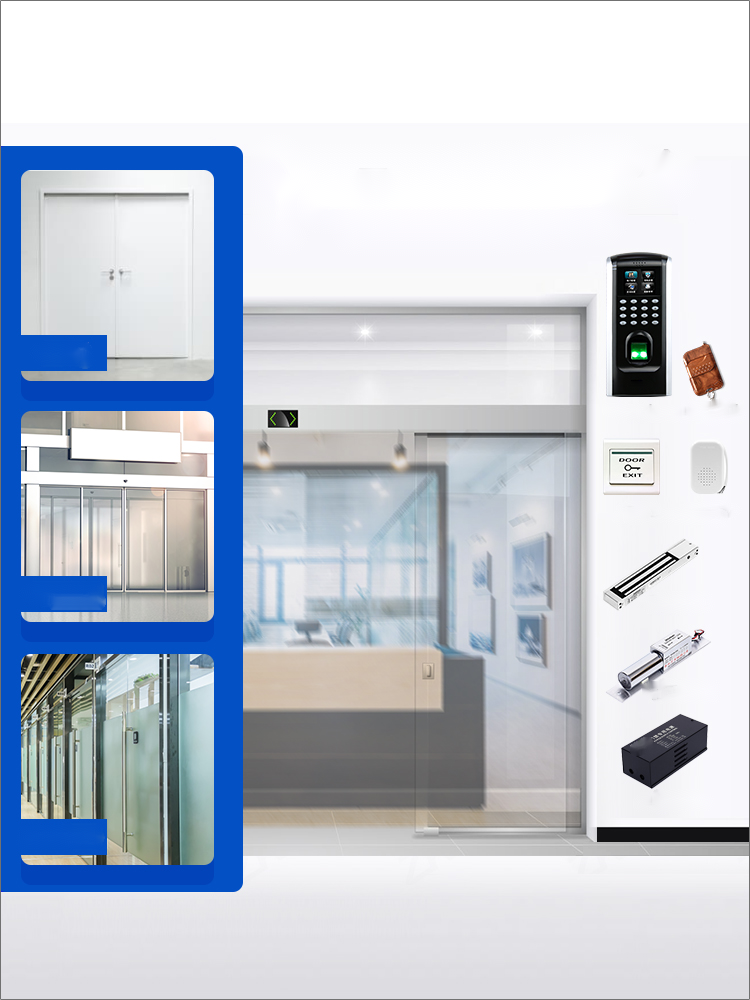
An intelligent access control system is a type of security management system that controls the entry and exit of individuals through electronic technology. It is widely used in office buildings, residential neighborhoods, schools, hospitals, and other locations. By employing identity verification and authority management, it ensures that only authorized personnel can access specific areas. Below are the main components and working principles of an intelligent access control system:
1. Main Components
Card Reader/Identification Device: Used to read the user's identity information. Common identification methods include:
IC Card/ID Card: Identity is verified by swiping the card.
Fingerprint Identification: Identity is verified through fingerprint scanning.
Face Recognition: Identity is verified through facial features.
Password Keypad: Identity is verified by entering a password.
Cell Phone/NFC: Identity is authenticated using a cell phone or NFC device.
Controller: Processes the information sent by the card reader or identification device and compares it with the database to determine whether to grant access.
Electric Lock: An electronic locking device installed on the door that performs the operation of opening or locking the door based on instructions from the controller.
Access Control Software: Manages user permissions, records access logs, sets time limits, and more.
Power Supply: Provides power to the entire system.
Network Device: Connects multiple access control devices to enable centralized management and remote control.
2. Working Principle
Identity Verification: Users are authenticated by swiping a card, entering a password, scanning a fingerprint, or using face recognition.
Information Matching: The card reader or identification device sends user information to the controller, which compares it with the authorized information in the database.
Permission Judgment: If the user information matches and the user has the necessary permissions, the controller sends a signal to the electric lock to open the door.
Log Recording: The system records the user's access time, location, and other information for future reference and management.
3. Advantages of Intelligent Access Control Systems
High Security: Multiple identity verification methods ensure that only authorized personnel can enter.
Convenient Management: Centralized management of multiple access points is possible through software, allowing for the setting of different permissions and time limits.
Auditable Records: The system automatically records all access logs, making it easy to trace activities.
High Flexibility: Permissions can be adjusted, and users can be added or removed as needed.
4. Application Scenarios
Office Buildings: Controls employee access, protecting company secrets and property.
Residential Neighborhoods: Limits entry by outsiders, ensuring resident safety.
Schools: Manages the entry and exit of students and staff, ensuring campus security.
Hospitals: Controls access to specific areas, protecting patient privacy and medical equipment.
5. Frequently Asked Questions and Solutions
Lost Cards: Cancel lost cards in the system promptly to prevent unauthorized use.
System Failure: Conduct regular maintenance and inspections to ensure the system operates normally.
Power Interruption: Equip the system with a backup power supply to prevent failure during outages.
6. Future Development Trends
Intelligence: With advancements in artificial intelligence and Internet of Things (IoT) technologies, access control systems will become more intelligent, capable of complex identification and behavior analysis.
Integration: Access control systems will integrate with other security systems (e.g., surveillance, alarm systems) to form comprehensive security solutions.
Contactless Identification: Future systems may increasingly use contactless identification technologies, such as face recognition and iris scanning, to enhance user experience and security.
Intelligent access control systems play a crucial role in modern security management. As technology continues to advance, their functionality and application scenarios will become even more extensive and intelligent.